According to the Readings, the Main Determinant of Strength Is:
Contents of Article
- Summary
- What is the Force-Velocity Curve?
- Practical Application
- The Grooming Zones (Sections of the Strength-Velocity Curve)
- Determination
- References
- About the Author
- Comments
Summary
The force-velocity curve is a concrete representation of the inverse relationship between strength and velocity. Understanding the interaction between forcefulness and velocity and their influences on exercise selection is vital for any force and conditioning professional. For example, it is essential that a strength and conditioning coach understands the physiological and biomechanical differences between prescribing a 1RM deadlift and 5RM jump squats – every bit one will produce college forces and lower velocities than the other. Failure to sympathise the relationship and its importance will probable lead to less than optimal training prescription.
What is the Strength-Velocity Curve?
Though the force-velocity curve may appear disruptive and complicated, it is actually very straight-forward. The force-velocity curve is just a relationship between forcefulness and velocity and can, therefore, be displayed on an x-y graph (Figure one). The 10-axis (i.eastward. horizontal axis) indicates velocity, for example, this may stand for muscle contraction velocity, or velocity of movement (measured in meters per second). Whilst the y-axis (i.e. vertical axis) indicates strength, for example, this may correspond muscle contractile strength, or the corporeality of ground reaction force produced (measured in Newtons).
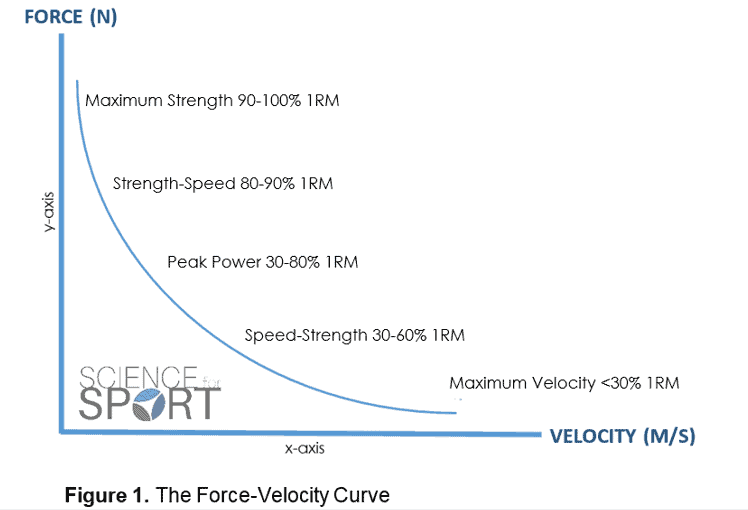
The curve itself shows an inverse relationship between forcefulness and velocity, meaning that an increase in strength would cause a decrease in velocity and vice versa. Giving an example, a i repetition maximum (1RM) Back Squat would produce loftier levels of force merely would be lifted at a slow velocity. While a countermovement leap (CMJ) would produce a high move velocity, it would likewise simply produce depression-levels of force. This indicates that there is a trade-off between forcefulness and velocity. That existence, when an exercise produces loftier levels of force, information technology volition also produce a slow movement velocity and vice versa.
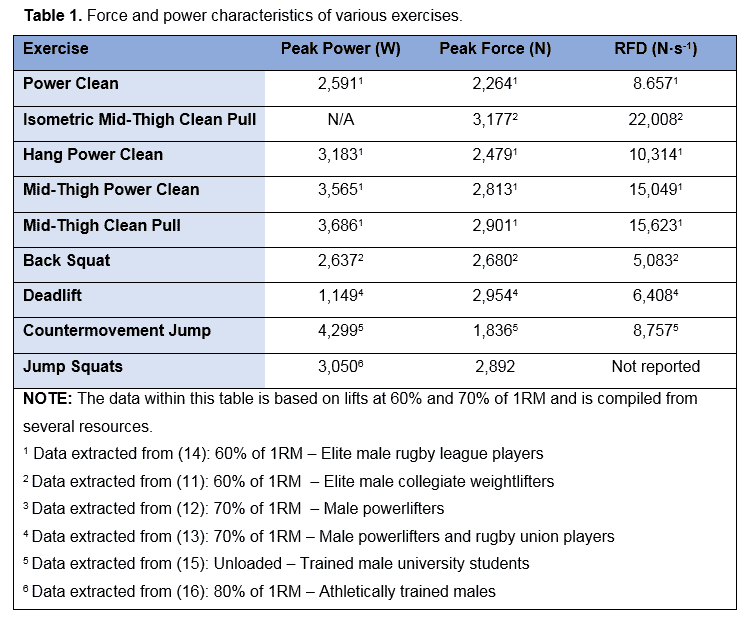
This merchandise-off between force and velocity is idea to occur due to a subtract in the time available for cross bridges to be formed – more fourth dimension, equals more cross bridges, and more cantankerous bridges mean a greater contractile forcefulness (one). Therefore, slower velocity exercises allow the athlete to course more cantankerous bridges and develop more force. Higher velocity exercises provide less fourth dimension for cross bridges to form, and therefore results in lower forcefulness product. As a event, different exercises and intensities accept been categorised into diverse segments on the force-velocity curve (Figure 1). In addition, Tabular array 1 demonstrates the force and velocity differences between numerous exercises. Here try and note the force and velocity differences betwixt the aforementioned exercises at various intensities.
Practical Awarding
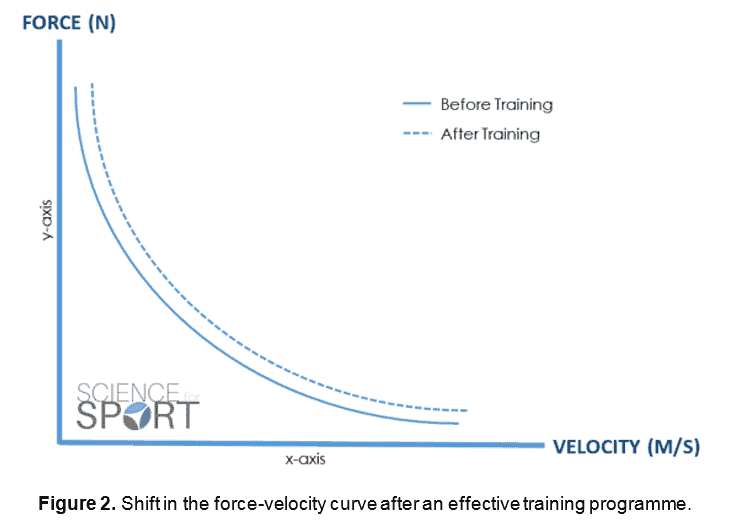
As ability is a central determinant in the performances of many sports, optimising an athlete'southward ability product is of not bad importance (vii, 8, 9, 10, eleven, 12). Considering power is the production of strength multiplied past velocity (Ability = Force * Velocity), improving either of these components can lead to increased power production and therefore the explosiveness of the athlete. In virtually circumstances, the primary objective of strength and power grooming is to shift the strength-velocity bend to the correct (Effigy 2), resulting in the athlete being able to move larger loads at higher velocities and therefore becoming more explosive. Shifting the strength-velocity curve to the correct represents an improved charge per unit of force evolution (RFD). The RFD only reflects how fast an athlete can develop force. An athlete with greater RFD capabilities volition be more explosive every bit they tin can develop larger forces in a shorter flow of time.
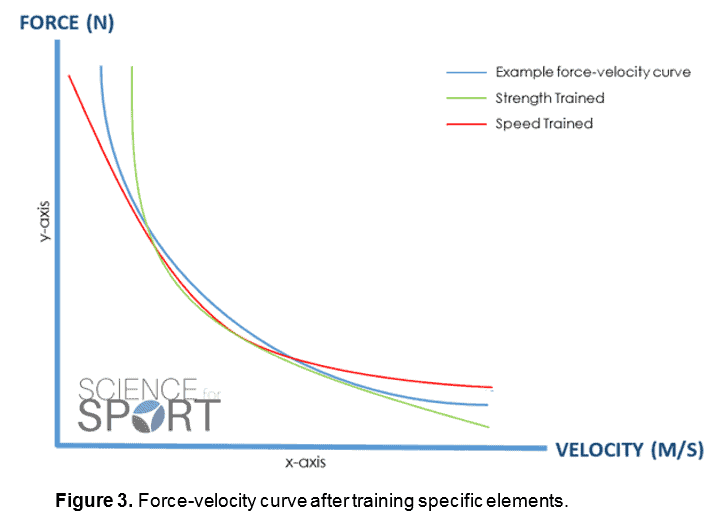
By only preparation on one role of the forcefulness-velocity bend (e.g. maximum strength), it is probable that the athlete volition only amend their performance at that department on the prototype (Figure three). For instance, only training maximal forcefulness may lead to improvements in forcefulness production, just it may likewise result in a reduction in muscle contractile velocity. As training programmes which combine strength and power training accept been repeatedly shown to meliorate athletic performance more than strength or speed training alone (13), there is no surprise that nearly strength and workout coaches normally use an all-rounded approach within their programming.
Although near athletes should typically railroad train at each section along the force-velocity curve, the time spent at each zone is dependent on many factors. Some main considerations include:
- Training age
- Individuals strengths and weaknesses
- Grooming objectives
- The sport and position of the athlete
- Time of year/ season/ stage of the macrocycle
Therefore all parts of the strength-velocity curve should typically be trained in order to maximise the explosiveness of the athlete. With that beingness said, there is often great debate between training multiple components of the force-velocity curve during one microcycle, or whether it is more effective to segregate information technology into separate blocks. Though this is an of import topic, information technology is inherently tied to preparation periodisation and is also broad for the scope of this article.
The Training Zones (Sections of the Force-Velocity Curve)
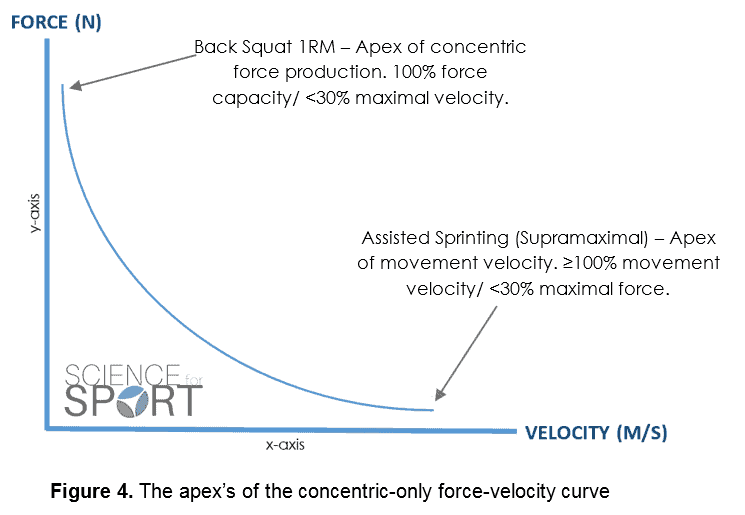
These zones are classified past the percentage of maximal strength or velocity an athlete can produce. For example, if an athlete's maximal force production during a Dorsum Squat 1RM is 3000N, then this would typically correspond 100% of their maximal strength capacity, and therefore appear at the apex of the concentric-only force bend (Figure four). The forcefulness pct and then works its fashion downward the curve until it reaches the maximal velocity where lilliputian force is produced. Likewise, the maximal velocity represents ≥100% of the athlete's maximal velocity of movement and appears at the apex of the velocity bend (Figure iv).
Maximal Strength
Maximal strength is simply the maximum corporeality of forcefulness someone is able to produce through a specific movement. For example, a 1RM Dorsum Squat would represent the maximum corporeality of force an athlete can produce during that particular exercise. Therefore, this training zone is typically classified by using intensities of approximately >90% of 1RM.
Exercise examples include: Dorsum Squat, Deadlift, and Bench Press @ xc-100% of 1RM, or any other exercise using this range of intensity.
Force-Speed
This is a nomenclature for exercises that are not deemed to deliver tiptop power output, nor peak force, then it sits in a then called 'centre-basis' between maximal strength and elevation power. As relatively high intensities are used within this zone (80-xc% of 1RM), it leans more than towards strength rather than speed – hence the 'forcefulness'-speed. The strength-speed zone requires an athlete to produce optimal forcefulness in a shorter timeframe than the maximal strength zone, and as discussed earlier, this reduces the corporeality of force that can be produced. Therefore, whilst the force-speed zone may produce lower peak forces than the maximal strength zone, it is able to achieve higher motility velocities.
Example exercises include: Olympic lifts (i.e. Snatch, Clean & Wiggle, Snatch Press @ 80-100% of 1RM).
Peak Power
This is a classification zone for exercises deemed to deliver peak power output. These exercises typically produce the greatest amount of force in the least amount of time. Substantially, ability sits in the heart of force-speed and speed-strength producing the optimal corporeality force in the shortest time timeframe possible (30-80% of 1RM).
Example exercises include: Second pull variations of the Clean and Snatch, Jump Squats, and Bench Press Throw @ xxx-80% of 1RM.
Speed-Force
Similar to forcefulness-speed, this zone does not deliver peak ability, nor peak velocity, so it sits in a 'middle-ground' between maximal velocity and peak power. Peak strength would be expected to be fifty-fifty lower here compared to strength-speed due to the greater restriction on time bachelor; still, move velocities will be higher. Equally relatively high velocities are used within this zone (30-60% of 1RM), it leans more than towards speed rather than strength – hence the 'speed'-force.
Example exercises include: Ho-hum stretch-shortening plyometric drills such as: countermovement jumps, and single-leg high hurdle jumps. Light-loaded Jump Squats (xxx-60% of 1RM).
Maximal Velocity
Maximal velocity is only the maximum move velocity, or muscle contractile velocity an athlete is able to produce through a specific motion. For example, a 100m Sprint may stand for the maximum movement velocity an athlete can produce during that particular exercise. Whereas, assisted sprinting, otherwise known every bit 'supramaximal sprinting' can produce ≥ 100% movement velocities. Therefore, this training zone is typically classified by using intensities of approximately < 30% of 1RM.
Practice examples include: Fast stretch-shortening plyometric drills such as: hopping, bounding, sprinting and assisted sprinting.
These unlike training zones are merely guidelines to various intensities and can be manipulated to fit the athlete in hand. They accept been developed by exercise professionals for educational purposes in order to demonstrate the effects of unlike exercises and intensities on able-bodied performance. However, each preparation zone, or section of the force-velocity bend, will provide different physiological adaptations, and therefore may have its own benefit for the athlete. For case, if an athlete is very strong (i.eastward. has a high 1RM), but performs poorly during speed tests (e.g. 20m sprint test), then spending time at the maximal velocity and speed-force zones may be of great benefit for the athlete.
Conclusion
The force-velocity bend demonstrates a simple changed human relationship between force and velocity – pregnant an increase in one results in a concurrent decrease in the other. This has potent implications for planning a preparation program and should be thoroughly considered when doing so. If an athlete lacks strength but is extremely fast, then perchance more fourth dimension should exist spent training at higher forcefulness intensities to ameliorate their strength capacity. The objective in most athletic training programmes is to ameliorate the athlete's RFD (i.e. explosiveness), resulting in a rightward shift in the force-velocity curve. Understanding the force-velocity curve is paramount to working as a strength and conditioning specialist, and explicit understanding is essential to becoming a great double-decker.
What now?
Some coaches believe that reading 1 article will make them an practiced on force and conditioning. Here'due south why they're wrong…
Strength and workout entails many, many topics. Past choosing to simply read up on The Strength-Velocity Bend and ignore the sea of other crucial Due south&C topics, you run the risk of being detrimental to your athlete's success and non realising your full potential.
To brand you lot an expert autobus and make your life every bit easy as possible, nosotros highly suggest y'all now check out this commodity on Force-Velocity Profiling.
References
Reference List (click here to open)
- Zatsiorsky, V., and Kraemer, J. (2006). Science and Practice of Strength Preparation. Champaign, Illinois: Human Kinetics. [Link]
- Aspe, RR and Swinton, PA. Electromyographic and kinetic comparison of the back squat and overhead squat. J Strength Cond Res 28(10): 2827–2836, 2014 [PubMed]
- Swinton, PA, Lloyd, R, Keogh, JWL, Agouris, I, and Stewart, Advertising. A biomechanical comparing of the traditional squat, powerlifting squat, and box squat. J Strength Cond Res 26(vii): 1805–1816, 2012. [PubMed]
- Swinton, PA, Stewart, AD, Keogh, JWL, Agouris, I, and Lloyd, R. Kinematic and kinetic analysis of maximal velocity deadlifts performed with and without the inclusion of chain resistance. J Strength Cond Res 25(11): 3163–3174, 2011 [PubMed]
- Cronin, J.B., McNair, P.J., & Marshall, R.N. (2003). Force-velocity analysis of strength training techniques and load: Implications for training strategy and research, Journal of Strength and Conditioning Research, 17(1), pp.148-155. [PubMed]
- Hori, Due north, Newton, RU, Kawamori, Due north,McGuigan,MR, Kraemer,WJ, and Nosaka, Thou. Reliability of functioning measurements derived from ground reaction force data during countermovement jump and the influence of sampling frequency. J Force Cond Res 23(3): 874–882, 2009 [PubMed]
- Baker, D and Nance, S. (1999). The relation between strength and power in professional person rugby league players. Journal of Strength and Workout Research, 13: 224–229. [Link]
- Comfort, P, Allen, K, and Graham-Smith, P. (2011). Kinetic comparisons during variations of the power clean. Journal of Strength and Workout Inquiry, 25: 3269– 3273. [PubMed]
- Comfort, P, Fletcher, C, and McMahon, JJ. (2012). Determination of optimal load during the power make clean in collegiate athletes. Journal of Strength and Conditioning Research, 26: 2970–2974. [PubMed]
- Cormie, P, McBride, JM, and McCaulley, Go. (2007). Validation of ability measurement techniques in dynamic lower trunk resistance exercises. J Appl Biomech 23: 103–118. [PubMed]
- Cronin, J, McNair, PJ, and Marshall, RN. (2001). Developing explosive power: A comparing of technique and training. J Sci Med Sport 4: 59–70. [PubMed]
- Garhammer, J. & Gregor, R. (1992). Propulsion Forces as a Part of Intensity for Weightlifting and Vertical Jumping, J. Appl. Sports Sci. Inquiry, half dozen(three): 129-134. [Link]
- Stone, Thousand.H., (1993). Literature review: Explosive exercises and training. National Strength and Conditioning Clan Journal, xv(iii), pp.vii-fifteen. [Link]
About the Author
Owen Walker
Owen WalkerMSc CSCS
Founder and Director of Science for Sport
Owen is the founder and director of Scientific discipline for Sport. He was formerly the Head of Academy Sports Science and Strength & Workout at Cardiff City Football Gild, and an interim Sports Scientist for the Welsh FA. He also has a primary's degree in force and conditioning and is a NSCA certified strength and conditioning omnibus.
Let us know what you idea of this article and how we could improve it for yous :). Tell us below…
suttongerizineink.blogspot.com
Source: https://www.scienceforsport.com/force-velocity-curve/

Postar um comentário for "According to the Readings, the Main Determinant of Strength Is:"