Why Would Akhenaten Change in the Religion Create Change in the Visual Arts?

Akhenaten, Nefertiti and three daughters beneath the Aten, Berlin
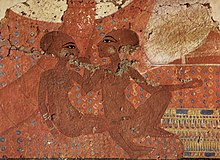
Two of Akhenaten'due south daughters, Nofernoferuaton and Nofernoferure, c. 1375–1358 BC. This comfortable and intimate family unit setting is repeated in other pieces of Amarna fine art
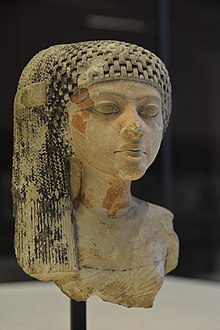
Princess of the Akhenaten family, Louvre
Amarna art, or the Amarna way, is a way adopted in the Amarna Period during and only after the reign of Akhenaten (r. 1351–1334 BC) in the late Eighteenth Dynasty, during the New Kingdom. Whereas Ancient Egyptian art was famously ho-hum to change, the Amarna mode was a meaning and sudden suspension from its predecessor both in the manner of depictions, especially of people, and the subject affair. The creative shift appears to be related to the male monarch's religious reforms centering on the monotheistic or monolatric worship of the Aten, the disc of the Sun, as giver of life.
Like Akhenaten's religious reforms, his preferred art style was abased subsequently the end of his reign. By the reign of Tutankhamun, both the pre-Amarna religion and art style had been restored.
Background and history [edit]
Shortly after taking the throne, Amenhotep 4 adopted a policy of religious reform centering on the Aten. While it is non articulate if he held that the Aten was the just god (monotheism), he conspicuously regarded it as the just deity worthy of his worship (monolatry). To pay homage to his chosen god, Amenhotep Iv changed his name to Akhenaten.[i]
Throughout his dominion, Akenaten tried to alter many aspects of Egyptian culture to gloat or praise his god. He moved the regal uppercase to the metropolis at present known equally Amarna and erected a number of palaces and temples at that place. He also extended his reforms to the way and usage of fine art.[ii]
The end of the Amarna period is unclear, equally records from the fourth dimension are sketchy. However, it is articulate that around the beginning of the reign of Tutankhamun, about four years later Akhenaten'south death, conservative forces led by the temple priests reimposed the old religion. The new uppercase was abandoned, and traces of his monuments elsewhere defaced. Remains of Amarna fine art are therefore full-bodied in Amarna itself, with other remains at Karnak, where large reliefs in the style were dismantled, and the blocks turned circular to face inwards when a later on building was synthetic using them. These were only rediscovered in recent decades.
General characteristics [edit]
Amarna art is characterized by a sense of movement and activity in images, with figures having raised heads, many figures overlapping and many scenes busy and crowded. The human torso is portrayed differently; figures, always shown in contour on reliefs, are slender, swaying, with exaggerated extremities. In detail, depictions of Akhenaten give him distinctly feminine qualities such as large hips, prominent breasts, and a larger stomach and thighs. Other pieces, such as the nigh famous of all Amarna works, the Nefertiti Bust in Berlin, show much less pronounced features of the style.
The illustration of figures' hands and anxiety are obviously important. Fingers and toes are depicted as long and slender and are carefully detailed to show nails. Artists also showed subjects with elongated facial structures accompanied by folds within the skin equally well as lowered eyelids. The figure was also illustrated with a more than elongated body than the previous representation. In the new human being form, the subject had more fat in the stomach, thigh, and breast region, while the torso, arm, and legs were thin and long similar the balance of the body.[3] The skin color of both male and female is generally dark chocolate-brown (assorted with the usual dark brownish or red for males and light dark-brown or white for females). Figures in this style are shown with both a left and a correct foot, contrasting the traditional style of existence shown with either two left or two right feet.
Art in the fashion [edit]
Tombs [edit]
The decoration of the tombs of not-royals is quite different from previous eras. These tombs practice not feature whatever funerary or agricultural scenes, nor do they include the tomb occupant unless he or she is depicted with a member of the purple family. There is an absence of gods and goddesses, apart from the Aten, the sundisc. However, the Aten does not shine its rays on the tomb possessor, just on members of the purple family. There is neither a mention of Osiris nor other funerary figures. There is also no mention of a journey through the underworld. Instead, excerpts from the Hymn to the Aten are generally present.

Akhenaten, Pharaoh of Egypt. Egyptian Museum, Cairo.
Sculpture [edit]
Sculptures from the Amarna catamenia are fix apart from other periods of Egyptian art. One reason for this is the accentuation of sure features. For example, the portrayals feature an elongation and narrowing of the neck and head, sloping of the brow and nose, a prominent chin, large ears and lips, spindle-similar artillery and calves, and large thighs, stomachs and hips.
In a relief of Akhenaten, he is portrayed in an intimate setting with his primary wife, Nefertiti, and their children, the six princesses. His children appear to exist fully grown, simply shrunken to appear smaller than their parents, a routine stylistic characteristic of traditional Egyptian fine art. They also take elongated necks and bodies. An unfinished head of a princess from this time, in the Tutankhamun, and the gilt age of the pharaohs exhibition, displays a very prominent elongation to the dorsum of the head.
The unusual, elongated skull shape ofttimes used in portrayal of the royal family "may be a slightly exaggerated handling of a hereditary trait of the Amarna purple family unit", co-ordinate to the Brooklyn Museum, given that "the mummy of Tutankhamun, presumed to be related to Akhenaten, has a similarly shaped skull, although not so elongated equally [in typical Amarna-style art]". Nevertheless, it is possible that the style is purely ritualistic.
The easily at the end of each ray extending from Aten in the relief are delivering the ankh, which symbolized "life" in the Egyptian culture, to Akhenaten and Nefertiti, and frequently also reach the portrayed princesses. The importance of the Sunday God Aten is central to much of the Amarna period art, largely because Akhenaten's rule was marked by the monotheistic following of Aten.
In several sculptures of Akhenaten, if not about, he has wide hips and a visible paunch. His lips are thick, and his arms and legs are thin and lack muscular tone, unlike his counterparts of other eras in Egyptian artwork. Some scholars suggest that the presentation of the human body as imperfect during the Amarna period is in deference to Aten. Others think Akhenaten suffered from a genetic disorder, well-nigh likely the production of inbreeding, that acquired him to expect that way. Others interpret this unprecedented stylistic break from Egyptian tradition to exist a reflection of the Amarna Royals' attempts to wrest political power from the traditional priesthood and bureaucratic authorities.
Much of the finest work, including the famous Nefertiti bust in Berlin, was found in the studio of the 2d and terminal Regal Court Sculptor Thutmose, and is now in Berlin and Cairo, with some in the Metropolitan Museum of Art, New York.
The period saw the use of sunk relief, previously used for large external reliefs, extended to minor carvings, and used for nigh monumental reliefs. Sunk relief appears all-time in strong sunlight. This was 1 innovation that had a lasting effect, every bit raised relief is rare in later periods.
Architecture [edit]
Not many buildings from this menstruum have survived the ravages of later kings, partially as they were constructed out of standard size blocks, known as talatat, which were very like shooting fish in a barrel to remove and reuse. In recent decades, re-edifice work on later buildings has revealed large number of reused blocks from the menses, with the original carved faces turned inward, profoundly increasing the amount of work known from the catamenia.
Temples in Amarna did not follow the traditional Egyptian blueprint. They were smaller, with sanctuaries open to the sun, containing large numbers of altars. They had no closing doors. Meet Great Temple of the Aten, Modest Temple of the Aten and the Temple of Amenhotep IV.
Gallery [edit]
-

Head of a daughter of Akhenaten. 18th Dynasty, c. 1345 BC. State Museum of Egyptian Art, Munich
-

Limestone trial piece showing head of Nefertiti. Mainly in ink, just the lips were cutting out. Reign of Akhenaten, Amarna. Petrie Museum
-
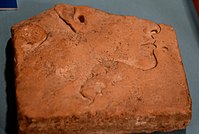
Limestone trial piece showing the distinctive Amarna-manner elongation of Akhenaten's face. Shallow sunk relief. Petrie Museum
-
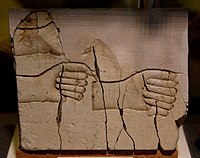
Limestone trial piece of hands. Amarna, Reign of Akhenaten, late 18th Dynasty. Petrie Museum
-

Limestone trial piece of a private person. Head of a princess on the reverse. Reign of Akhenaten, Amarna. Petrie Museum
-

Princess, Amarna
See also [edit]
 | Wikimedia Commons has media related to Amarna art. |
- Art of aboriginal Arab republic of egypt
- Amarna messages
References [edit]
- ^ Spence, Kate. "Akhenaten and the Amarna Menses". bbc.co.uk . Retrieved September 27, 2015.
- ^ Doyle, Noreen (September 2007). "Akhenaten's Fine art". Calliope . Retrieved Oct 27, 2015. [ permanent expressionless link ]
- ^ Hill, Jenny. "Amarna Art". ancientegyptonline.co.united kingdom of great britain and northern ireland . Retrieved September 27, 2015.
External links [edit]
- 'Gifts for the Gods: Images from Egyptian Temples, a fully digitized exhibition catalog from The Metropolitan Museum of Art Libraries, which contains cloth on Amarna fine art
suttongerizineink.blogspot.com
Source: https://en.wikipedia.org/wiki/Amarna_art

Postar um comentário for "Why Would Akhenaten Change in the Religion Create Change in the Visual Arts?"